
In short, asphalt is cheaper, faster, and easier to repair, while concrete lasts longer and handles very heavy loads better. For most Australian homes, asphalt wins on cost and turnaround. Concrete wins if you’ve got a truck-rated requirement, want a polished finish, or plan to be in the house 30+ years. Here’s the longer story.
Quick comparison: asphalt vs concrete driveway in Australia (2026)
| Factor | Asphalt | Concrete |
|---|---|---|
| Cost per m² installed | $70–$95 | $110–$160 (plain), $180–$260 (decorative) |
| Lifespan | 20–25 years | 30–40 years |
| Install time | 1 day | 2–3 days + 7 day cure |
| Drive-on time | Next day | 7 days minimum |
| Repair cost | Cheap, patch and forget | Expensive, often replace the slab |
| Heat in summer | Hotter underfoot | Cooler |
| Salt-air durability | Excellent with sealcoat | Excellent |
| Best for | 60–200m² suburban driveways | Heavy vehicles, decorative finish |
What’s the price difference?
In 2026, a standard 80m² driveway costs around $5,600–$7,600 in asphalt and $8,800–$12,800 in concrete. That’s roughly 40–60% more for concrete on like-for-like.
The gap widens with size. A 200m² rural driveway in asphalt might run $14,000. The same job in concrete blows past $24,000, partly because you need control joints, expansion gaps, and reinforcement mesh that asphalt doesn’t.
Why is concrete more expensive?
Three reasons. Material costs more per m³, you need steel mesh and prep that asphalt skips, and the job runs over three days instead of one. Labour adds up fast when the crew is on site longer.
Does asphalt look cheap?
Honestly, modern hot-mix laid by a proper crew looks sharp — tight edges, even surface, deep black. The "cheap-looking" asphalt you see is usually a botched job: thin mix, no rolling, hand-spread. A well-laid asphalt driveway looks every bit as good as plain broom-finish concrete, and you save thousands.
Which lasts longer in Australian conditions?
Concrete lasts longer on paper — 30–40 years vs 20–25 for asphalt. But two things matter in practice on the Central Coast.
First, concrete cracks. Once it cracks, you’re either living with it or replacing the slab. There’s no easy patch that doesn’t look like a patch. Asphalt cracks too, but you can sealcoat and crack-fill every 5–7 years and reset the clock.
Second, Aussie ground moves. Reactive clay soils — common across NSW and most of QLD — heave and shrink with the seasons. Asphalt flexes with the movement. Concrete doesn’t. We’ve seen 15-year-old concrete driveways in Wyong cracked through because the clay underneath kept moving.
When is concrete the better choice for lifespan?
Heavy commercial use, fully sealed industrial yards, anywhere a truck >10 tonnes parks regularly. The rigid slab spreads the load better. For a normal family car or two, asphalt is plenty.
How long does an asphalt driveway last in salt-air coastal conditions?
20–25 years if it’s sealcoated every 5–7 years. Without sealing, expect 15. We’ve done driveways at Avoca and Terrigal in the late 90s that are still going — owner kept up the maintenance.
What about repairs and maintenance?
Asphalt is dramatically easier to repair. A pothole or edge crumble in asphalt? Cut out the bad bit, infill with hot mix, roll it. Done in an hour, $200–$400. Same problem in concrete? You’re looking at saw-cutting, demolition, rebar, formwork, fresh pour, and a week of cure. $1,500–$3,000.
Maintenance schedule:
- Asphalt: sealcoat every 5–7 years (~$2–$4 per m²), crack-fill as needed
- Concrete: seal every 3–5 years if decorative ($3–$6 per m²), no crack-fill option
Plain concrete needs less ongoing love, but when something does go wrong, the fix is brutal. Asphalt is the opposite — small regular spends, easy fixes.
Install time: how fast can each be laid?
Asphalt is a one-day job for most suburban driveways. We tip up at 7am, prep, lay the mix, roll, and you’re driving on it the next morning. Concrete is 2–3 days for the pour and finishing, then 7 days minimum before you put a wheel on it. For larger pours you’re waiting two weeks for full strength.
If you’ve only got one car and one driveway, that week of cure is a real pain. Park on the street, kids walking around the slab, plywood ramps over the gutter. Asphalt skips all of that.
Can you do half-and-half?
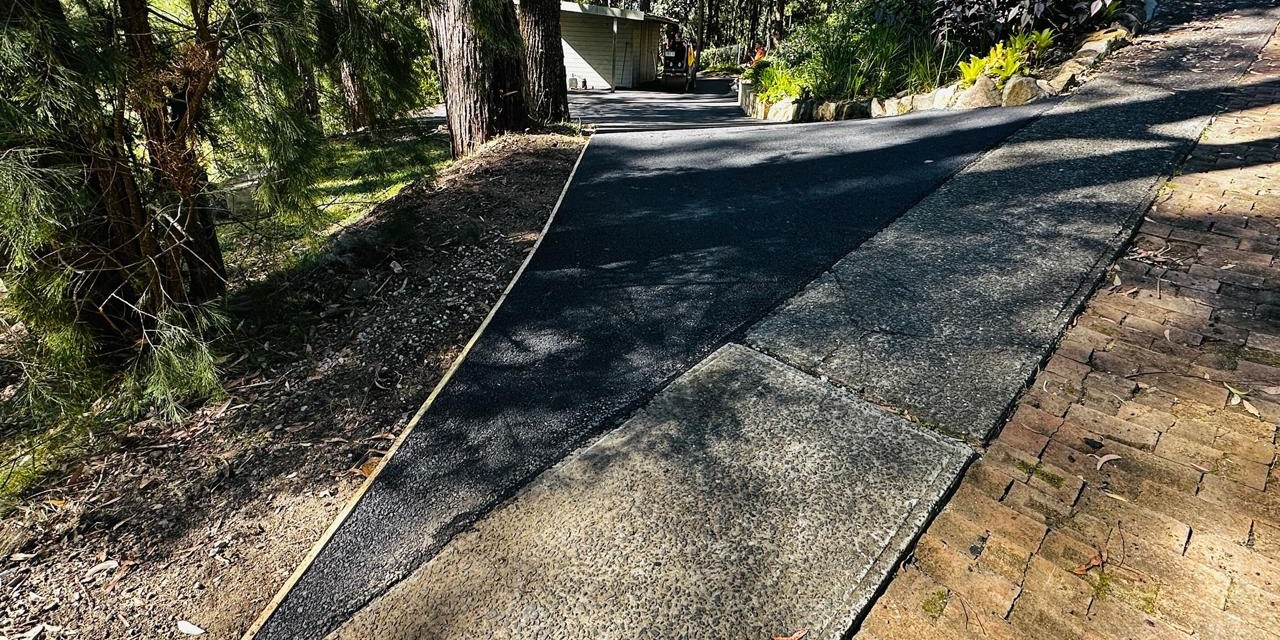
Yes — common in steep coastal sites. Concrete the top section near the garage where oil drips and turning forces are worst, asphalt the long run down to the street. Best of both, around $9,000–$12,000 for 100m² done this way.
Cracking, heat, and salt — the Australian reality
Three things hit driveways harder here than in Europe or North America:
Heat. Asphalt softens above 50°C. Black asphalt in a Western Sydney summer can hit 65°C surface temp. It won’t melt, but heavy point loads (caravan jockey wheels, motorbike stands) can leave dimples. Concrete stays rigid but the surface gets brutally hot to walk on barefoot.
UV. Both surfaces fade. Asphalt greys out over 3–5 years — sealcoat brings it back. Concrete stays roughly the same colour but can chalk.
Salt and bushfire ash. Coastal homes get salt deposits. Bushfire-prone areas get ash. Both surfaces handle these fine with washing, but sealcoated asphalt resists salt-driven oxidation better.
Does asphalt soften in Aussie summer?
Surface softening, yes — you can sometimes scuff fresh asphalt with a heel on a 40°C day in the first month. After it cures fully (about 6 months), it’s stable. AC10 mix used residentially is rated for Australian conditions.
When concrete wins outright
Be honest with yourself if any of these apply:
- You’re parking trucks or heavy machinery over 10 tonnes regularly
- You want a stamped, coloured, or exposed-aggregate finish for a high-end home
- The driveway is short (under 30m²) — the per m² premium hurts less on small jobs
- You’re in a council area with reactive clay AND you can afford engineered slab + waffle pod base
For everyone else — and that’s most Aussie homes — asphalt is the smarter spend.
What about resale value?
Real estate agents we talk to on the Coast say the difference between a tidy asphalt driveway and a tidy concrete driveway adds maybe $2,000–$5,000 to perceived value. Either is fine. The killer for resale is a cracked, weed-infested, half-collapsed driveway. Spend the money on something that’s well-installed and well-maintained, regardless of material.
For a deeper dive on pricing, see our Central Coast asphalt driveway cost guide or how long asphalt lasts in Australian conditions.
For technical detail on Australian asphalt mix design, the Australian Asphalt Pavement Association (AAPA) publishes industry guidelines.
FAQs
Is asphalt cheaper than concrete in Australia?
Yes. In 2026, asphalt runs $70–$95 per m² installed, concrete runs $110–$160 per m² for plain broom finish, more for decorative. On an 80m² driveway, you save $3,000–$5,000 going asphalt.
Which is better for a steep driveway, asphalt or concrete?
Concrete handles slope better on paper because it’s rigid. But asphalt with the right mix (AC14 instead of AC10) and proper edge restraint works fine on grades up to 1:5. We’ve done 1:4 driveways in Terrigal in hot mix that have held up 15+ years.
How long does asphalt last in Australia?
20–25 years with sealcoating every 5–7 years. Without maintenance, expect 15. Concrete lasts 30–40 years but is brutal to repair when it does fail.
Want a fair quote on an asphalt driveway? Glenn or one of the crew can come out for a free site visit — send through the quote form or call. We cover the whole Central Coast.