
In short, asphalt driveway edges crumble because they’re unsupported at the side, water gets under them from soft soil or lawn, and they were probably laid too thin. Fix: cut the bad edge cleanly, lay edge restraint (paver, concrete strip, or compacted shoulder), and repair with hot-mix patch. Prevention: every new driveway should have proper edge support designed in. Here’s the longer story.
Why asphalt driveway edges fail first
The middle of a driveway is held in place on all four sides. The edges are held on three sides — or worse, two. That’s why edges always fail first. Add water erosion from the lawn side and you have the most common failure mode in Aussie driveways.
Quick reference: edge failure causes
| Cause | How common | Fix |
|---|---|---|
| No edge restraint, just grass | Most common | Install paver edge or concrete strip |
| Soft soil shoulder, water erosion | Very common | Compact base, install drainage if needed |
| Asphalt laid too thin at edge | Common | Strip and re-lay edge with proper depth |
| Tree roots from below | Common in suburbs | Root barrier or tree removal |
| Lawn mower damage | Common | Edging board, mower clearance |
| Heavy vehicle riding the edge | Less common | Don’t park with wheels on edge |
| Frost heave (rare in NSW) | Rare | Better base prep |
The fix depends on the cause, but in 90% of edge failure cases we see on the Central Coast, proper edge restraint was never installed. The asphalt was laid flush to a grass shoulder with nothing holding it.
The physics of an asphalt edge
Hot-mix asphalt is laid at 140–160°C and rolled by a 1.5–3 tonne roller. The roller can only get to within 50–100mm of the actual edge. That last edge strip is hand-finished with a tool and rolled with a smaller plate compactor — never as fully compacted as the middle.
Result: the outer 50–100mm of an asphalt driveway is always slightly less dense than the rest. That density gap makes the edge:
- More porous (water gets in faster)
- Lower strength (cracks form more easily)
- More vulnerable to lateral movement (no kerb or paver to push against)
This is why edges fail — they’re physically weaker by design. The question is what you do about it.
Why does my driveway crumble at the lawn edge but not the garage edge?
The garage side has a concrete threshold supporting the asphalt. The lawn side has nothing — just soil and grass. Same asphalt, different support, different failure rate. The garage edge can last 25 years; the lawn edge fails at 8.
Is it just my driveway or do all driveways do this?
All driveways with unsupported edges fail at the edges first. Properly edge-restrained driveways (paver edging, concrete strips, kerb) hold up far longer at the edge.
The 7 main reasons edges fail
1. No edge restraint
The single biggest cause. Asphalt laid flush against grass has nothing to push against. Cars riding over the edge slightly, lawn mower wheels running on the asphalt, water washing the soil out from underneath — all stress the edge.
2. Soft soil shoulder
If the soil beside the driveway is loose topsoil or undisturbed clay, water erodes it from the side, the base loses lateral support, and the asphalt cracks down from the surface.
3. Laid too thin
A 20mm edge on a 30mm driveway is common — the laydown crew tapers the edge to manage flow. Thinner asphalt cracks faster. Edges should be at least 80% of the main driveway thickness.
4. Tree roots
Surface tree roots push asphalt up from underneath, creating bumps that then crack. Subsurface roots can split the driveway from below. Gum trees, jacarandas, paperbarks, and figs are the worst offenders on the Coast.
5. Lawn mower damage
The edge of a mower deck running over an asphalt edge gradually chips and chews the surface. Whipper-snipper line hitting the edge scuffs the surface and wears it.
6. Heavy vehicles riding the edge
Service trucks, removalists, oil tankers — heavy vehicles that drive partially on the edge with a tyre put massive point loads on the weakest part of the pavement.
7. Drainage running along the edge
Water from gutters, downpipes, or hard-surface runoff that flows along the driveway edge erodes soil, undermines the base, and gradually drops the edge.
Can I tell which cause is mine?
Walk the edge. Crumbling and chipping with loose stones underneath: density failure, edge was too thin. Edge has dropped 10–20mm relative to lawn: soft shoulder + water erosion. Cracks running parallel to the edge: root or soil movement. Cracks crossing the edge perpendicular: vehicle stress.
How to fix a failing driveway edge
Light damage: under 30mm chipped, edges still mostly intact
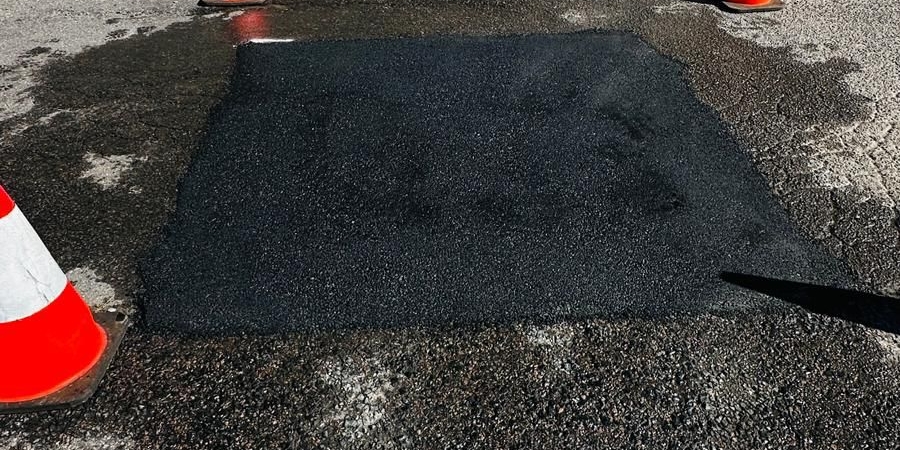
Crack-seal any cracks 3mm+, fill chips with hot-mix patch ($150–$300 for a short section), install edging strip (paver, treated timber, or compacted gravel shoulder). Cost: $300–$800 for a typical residential driveway.
Moderate damage: 30–100mm of crumbling along the edge
Saw-cut the bad edge clean, excavate 50–100mm wide of the damaged section, install edge restraint, infill with fresh hot mix, hand-rolled. Cost: $1,200–$2,800 for a typical 20m of edge.
Severe damage: edge has dropped and the driveway is cracking inward
The base has failed for 200mm in from the edge. Strip out the bad zone, rebuild the base with road base and geotextile, re-lay asphalt with proper edge support. Cost: $3,500–$6,500 for a typical residential job.
Whole-driveway edge failure
If the entire perimeter has gone, the original edge support was missing across the whole job. Easier to plan a full resurface with edge restraint installed as part of the works. Cost: comparable to a full resurface ($3,400–$4,800 for 80m²) plus $20–$35 per linear metre of edging.
Can I DIY an edge repair?
Cold-mix patch from Bunnings will handle a small chipped corner ($30–$60 of material). Anything longer than a metre or wider than 50mm, get a pro. The patch alone isn’t the fix — you need the edge restraint too, or it’ll fail again.
How to prevent edge failure on a new driveway
Three options, cheapest to most expensive:
Option 1: Compacted shoulder
At laydown, the contractor compacts a 200mm wide shoulder of road base alongside the new asphalt at the same level. Cost: usually included in the quote. Lifespan: ~10 years before the shoulder erodes.
Option 2: Paver edge
A row of clay or concrete pavers set in mortar along the driveway edge. Acts as a permanent restraint. Cost: $25–$45 per linear metre. Lifespan: 25+ years.
Option 3: Concrete edge strip
A 150mm wide concrete strip poured along the driveway edge, sometimes integrated with a kerb. Cost: $40–$60 per linear metre. Lifespan: 30+ years.
For an 80m² driveway with 20m of vulnerable edge, paver edging adds $500–$900 to the quote. Concrete strip adds $800–$1,200. Either pays for itself in avoided edge repairs within 10 years.
Should every new driveway have edge restraint?
If the driveway edge runs alongside grass or soft soil — yes. If it runs alongside an existing concrete path, kerb, or wall — no, that’s the restraint. Most residential driveways on the Coast have at least one side running along grass, so most need it.
Tree management at driveway edges
If there’s a tree within 3 metres of the driveway, you need to plan for root pressure. Options:
- Root barrier at construction — a 600mm deep plastic or geotextile barrier installed between tree and driveway. Best done before laying.
- Root pruning — cutting major roots that are threatening the pavement. Specialist arborist work. Damages the tree.
- Tree removal — sometimes the right answer if the tree is the wrong species in the wrong place.
Common offenders on the Central Coast: gum trees (especially Eucalyptus tereticornis), Norfolk pine, fig (Ficus spp.), jacaranda. Their root systems lift asphalt within 8–12 years of a new pavement going in nearby.
Can I patch over tree-root damage?
Temporarily, yes. Permanently, no — the roots will keep growing and re-lift the patch. You need to deal with the tree or relocate the driveway.
Edge restraint and pavers — long-term considerations
If you install a paver edge, plan for two things:
- The pavers will need re-pointing every 5–10 years as mortar between pavers cracks. Cheap fix (~$5/m).
- The asphalt-paver join will need re-sealing every 3–5 years with bitumen-based joint sealer ($2–$4/m).
These are small ongoing costs but matter for long-term performance. A maintained paver edge can outlast the asphalt itself.
For technical detail on driveway edge restraint and pavement edge design, see Austroads pavement guidelines.
FAQs
Why is my asphalt driveway crumbling at the edges?
Three main reasons: the edge was laid too thin (under 80% of main thickness), there’s no edge restraint to hold the asphalt against lateral movement, and water from soft soil or lawn is eroding the base from the side. All three are common and all three are fixable.
How do I stop my driveway edges from crumbling?
Install edge restraint — a row of pavers, a concrete strip, or even a properly compacted gravel shoulder. Then repair the existing damage with hot-mix patch. Without edge restraint, repairs will fail again within 3–5 years.
How much does it cost to repair driveway edges?
Light edge repair (chipping, small cracks, install paver edging): $300–$800. Moderate edge rebuild with restraint and fresh asphalt: $1,200–$2,800. Severe edge plus base failure: $3,500–$6,500.
Should I just resurface the whole driveway if edges are failing?
If edges are failing across the whole perimeter AND the surface is also tired, yes — a full resurface with new edge restraint built in is the smart move. If edges are failing but the rest of the driveway is fine, just fix the edges. See our sealcoat vs resurface guide.
Got crumbling driveway edges? Glenn or one of the crew can walk it with you and tell you whether it’s a $400 fix or a $4,000 fix — send through the quote form. We’ve been dealing with this on the Coast for 30+ years; no two driveways are quite the same.