
How Long Does an Asphalt Driveway Last on the Central Coast?
A well-laid asphalt driveway on the Central Coast lasts 20 to 25 years. With yearly maintenance, you can stretch that to 30. UV exposure, salt air near the beaches, clay subgrade, and 35°C+ summer days are the four lifespan killers. Sealing every 5-7 years adds a decade.
I’ve watched driveways I laid in 2002 still going strong, and I’ve watched driveways laid in 2018 fail by 2024. The difference isn’t the asphalt. It’s everything underneath, and what the owner did (or didn’t do) in years 1 through 5. Here’s the full picture.
Short Answer: 20-25 Years
For a standard 25mm to 30mm hot mix asphalt driveway, properly prepared and laid:
- Bare minimum: 15 years (no maintenance, poor base, sun-blasted)
- Average: 20 to 25 years (typical Central Coast home)
- Best case: 30 years (sealed every 5-7 years, good base, partial shade)
That’s longer than most cars last and about the same as a colorbond roof. For a one-time $7,000 investment, asphalt is the best value driveway material going.
4 Lifespan Killers on the Central Coast
The Coast is particularly hard on asphalt. Four things shorten driveways here more than in inland NSW:
UV Oxidation
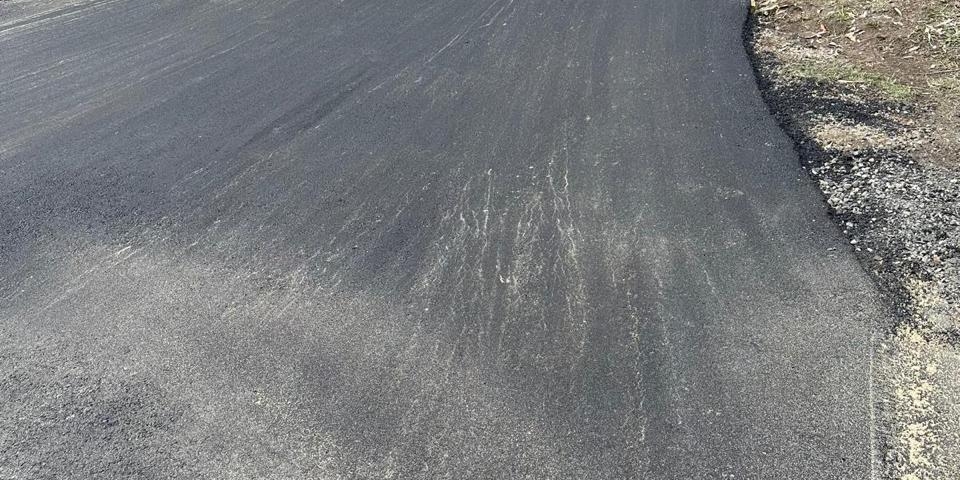
The big one. UV breaks down the bitumen binder, turning it from black and flexible to grey and brittle. You can see it happening. A fresh driveway is jet black. By year 5, it’s charcoal grey. By year 10 without sealing, it’s pale grey with visible aggregate.
Once the binder oxidises, water gets in. Once water gets in, cracks form. Once cracks form, the base starts to fail.
UV exposure on the Coast is brutal. Driveways with north-west afternoon sun (most of them) age faster than south-facing ones.
Salt Air
If you’re within 5km of the beach (Avoca, Macmasters, Terrigal, Forresters, The Entrance, Toukley, Norah Head, anywhere on the lake), salt air accelerates everything. Salt is hygroscopic, it pulls moisture into the surface. Combined with UV, the binder breaks down 20% to 30% faster than inland properties.
A Terrigal driveway will need its first reseal at year 5. The same driveway at Wyong inland might wait until year 7.
Clay Subgrade
Plenty of Central Coast suburbs sit on reactive clay. Wyong, Tuggerah, Berkeley Vale, parts of West Gosford, and most of the rural blocks west of the M1. Clay shrinks in summer and swells in winter. That ground movement transfers up through the asphalt.
If the base isn’t deep enough (200mm minimum on clay), the driveway will develop long longitudinal cracks within 5 years. Once those cracks are in, you’re chasing them for the rest of the driveway’s life.
Summer Heat
The Coast hits 35°C several times each January and February. Black asphalt absorbs heat and can reach surface temperatures of 65°C+. Hot asphalt is soft asphalt. Heavy vehicles parked for hours, jack stands, kickstands from motorbikes, all leave permanent indentations.
This is worse on steep driveways because the softened mix can creep downhill under sustained heavy load. We’ve replaced sections of Avoca and Macmasters driveways where caravans sat for a summer.
Year-by-Year: What to Expect
Here’s the realistic timeline for a well-laid asphalt driveway on the Coast:
Year 1
- Driveway settles slightly under traffic
- Surface still jet black, no cracks
- Some fine cracking around manhole covers (normal)
Years 2-5
- Surface starts to fade to dark grey
- Hairline cracks may appear at edges and around joints
- First reseal recommended in year 5
Years 6-10
- Without reseal: visible aggregate, surface starting to ravel
- With reseal in year 5: still looks 2 years old
- Edge cracks lengthen, some may need crack sealing
- Year 10 reseal extends life significantly
Years 11-15
- Some shrinkage cracks forming, especially on clay subgrade
- Surface may develop minor depressions in wheel tracks
- Areas under trees show more cracking
- Time for crack repairs, second reseal
Years 16-20
- Visible aging, but functional
- Spot patches may be needed where roots have lifted
- Edges may need repair
- Start budgeting for resurface
Years 21-25
- End of life for many driveways
- Decision time: resurface (overlay) or full replacement
- Multiple cracks, possible base failure in places
Years 26-30
- Only with consistent maintenance gets you here
- Likely full replacement on the horizon
Maintenance Schedule to 30 Years
Want to make 30 years? Do this:
| When | What | Cost |
|---|---|---|
| Year 1 | Inspect, photograph baseline | Free |
| Year 2 | Crack seal any cracks over 5mm | $200 to $400 |
| Year 5 | First reseal (sprayed seal or sealcoat) | $5 to $9 per m² |
| Year 5 onwards | Crack seal yearly in autumn | $4 to $8 per linear metre |
| Year 10 | Second reseal | $5 to $9 per m² |
| Year 12-15 | Spot patches as needed | $500 to $1,500 each |
| Year 15 | Third reseal | $5 to $9 per m² |
| Year 18-22 | Major patching or partial resurface | Varies |
| Year 22-25 | Full resurface (25mm overlay) | $40 to $55 per m² |
A $6,000 driveway maintained this way costs about $4,500 over 25 years in upkeep. Replacement at year 30 instead of year 18 saves you the cost of a second driveway.
Signs You’re at End of Life
Time to call it when you see:
- Alligator cracking (interconnected cracks that look like crocodile skin) over more than 20% of the surface
- Wheel ruts deeper than 25mm in the tyre tracks
- Multiple potholes in the same square metre
- Edge break-up where the edges are crumbling away
- Major depressions where the base has failed
- Persistent puddling showing the surface no longer sheds water properly
One or two of these means repair. Four or more means it’s time to resurface or replace.
Repair vs Resurface vs Replace: Decision Tree
Repair (patches and crack seal) if:
- Damage is in less than 15% of the surface area
- Base is still sound (no soft spots)
- Driveway is under 15 years old
- Cost: $500 to $3,000 typical
Resurface (overlay) if:
- Surface is failing but base is mostly intact
- Driveway is 15-25 years old
- Existing surface can be levelled and tack coated
- Cost: $40 to $55 per m² (about 55% of new driveway cost)
Replace (full reconstruction) if:
- Base has failed in multiple areas
- Driveway is over 25 years old
- Alligator cracking over more than 30% of surface
- Drainage problems can’t be fixed with an overlay
- Cost: $70 to $95 per m² (full price)
For the detailed pricing, see our 2026 driveway cost guide or have a look at asphalt repair services. For a free site assessment, send through the quote form and we’ll tell you straight whether it’s worth repairing or time to replace.
FAQs
Should I seal my asphalt driveway in NSW?
Yes, sealing extends driveway life by 10 to 15 years on the Central Coast. First seal at year 5, then every 5 to 7 years after. A sprayed seal costs $5 to $9 per m², so $400 to $700 for a typical residential driveway. Compare that to the $6,000+ cost of full replacement and it’s the best maintenance dollar you spend.
Will salt air shorten my driveway’s life?
Yes, but not dramatically. Salt air homes within 5km of the coast see 20% to 30% faster binder oxidation than inland properties. Practically, that means resealing at year 5 instead of year 7. With proper maintenance, beachfront driveways still hit 25 years comfortably.
Should I worry about cracks in my driveway?
Depends on the crack. Hairline cracks under 3mm are cosmetic and normal. Cracks 3mm to 10mm wide should be sealed with hot rubber crack sealer in the next 6 months. Cracks wider than 10mm, especially those with vegetation growing through or visible depression, mean the base is moving and you need a contractor on site. Spider-pattern cracks (alligator cracking) are the most serious, they mean base failure.
Got questions about your Central Coast driveway or carpark? Glenn or one of the crew will pick up, 0447 039 682. Or send through the quick quote form and we’ll come out for a free site visit.